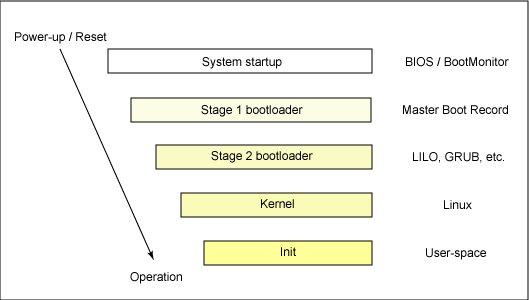
The init process :

Depending on the default init level setting, the system will execute the programs from one of the following folders :
- completes the boot procedure
- have the process ID '1'
- starts the system processes (as described in /etc/inittab)
- is not part of the kernel, it belongs to the user space ( /sbin/init )
- never dies : it handles the operating system's life cycle (restart, shutdown,..)
- sysvinit : linux traditional init program
- upstart : used by most of the linux distributions
- systemd : Fedora
- busybox : for small embedded systems
Run level
At boot, init checks the inittab configuration file for the runlevel parameter. This value goes from 0 to 6 and a specific set of actions is executed for each of them.
Depending on the default init level setting, the system will execute the programs from one of the following folders :
- Run level 0 : /etc/rc.d/rc0.d
- Run level 1 : /etc/rc.d/rc1.d
- Run level 2 : /etc/rc.d/rc2.d
- Run level 3 : /etc/rc.d/rc3.d
- Run level 4 : /etc/rc.d/rc4.d
- Run level 5 : /etc/rc.d/rc5.d
- Run level 6 : /etc/rc.d/rc6.d
In these directories, the program names start with either S or K followed with a sequence number and the program name.
- The programs starting with an S are executed on system Start while the programs starting with a K are executed on system Kill.
- The sequence number indicates when the program has the be executed.
For example, S12syslog has to be started before S80sendmail.


